Design Overview
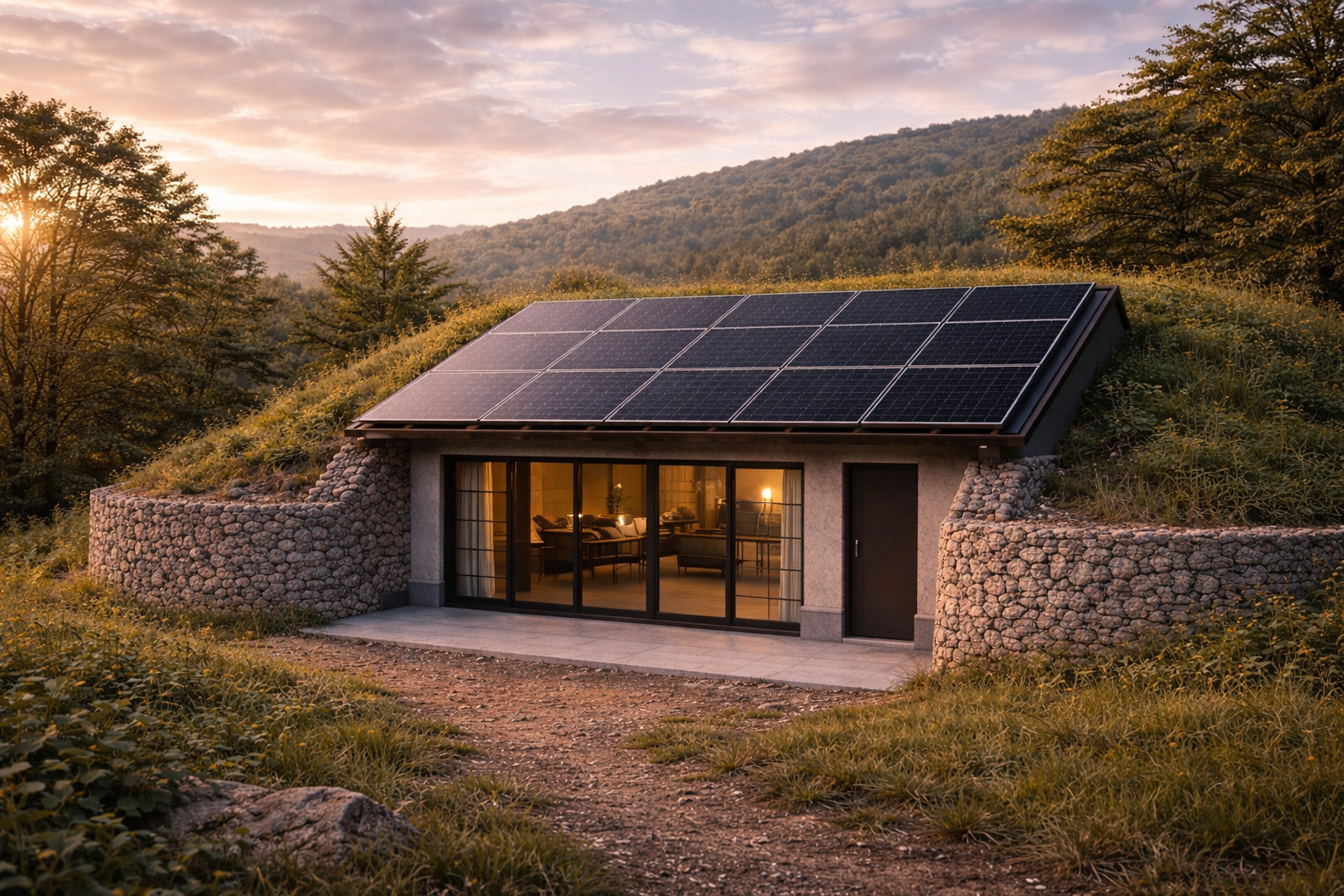
The Earth Sheltered SolarPod is a 5×6m rectangular earth-sheltered structure. Unlike the Standard BioDome’s circular dome, this design is cut 3 meters into a hillside, using the earth itself as thermal mass and fire protection. The rectangular footprint integrates naturally with hillside contours, creating a 30m² sheltered space that breathes with the land.
Twenty-two square meters of wall surface are banked against the hillside, providing passive cooling in summer and warmth retention in winter. The 3m cut depth puts the rear wall entirely below grade. This is not a bunker — the south-facing front is fully open with a glazed door and windows, bringing light deep into the interior. The earth-contact walls stabilize interior temperature year-round, reducing heating and cooling needs to near zero.
The SolarPod’s signature innovation is its roof: Leonardo da Vinci’s self-supporting bridge principle, adapted as A-frame gable rafters. In the Codex Atlanticus (1480s), da Vinci sketched a bridge where interlocking beams hold together through geometry alone, no fasteners required. Here, that same principle creates A-frame rafter pairs spanning the 5m width. Each pair interlocks with its neighbors across the rectangular span, forming a strong gable roof without a ridge beam or central support. Where the Standard BioDome uses full-span arches for a dome, the SolarPod translates the interlocking principle into A-frame pairs spanning a rectangle.
The hillside cut is retained with gabion walls — stone-filled wire cages that serve dual purpose. They hold back the earth and provide the structure’s rear and side foundations. The front gabion course anchors the wattle wall frame and door threshold. The gabions create a stable bearing surface for the eucalyptus pole frame, while allowing subsurface water to drain freely through the stone fill.
The A-frame gable creates an ideal south-facing slope for solar panel mounting. Unlike a dome (which has no flat surface facing south), the SolarPod’s geometry was designed with solar harvest in mind. The north-facing slope carries the living roof — a sedum and native grass layer providing thermal mass, fire resistance, and visual integration with the hillside. The south-facing slope mounts photovoltaic panels, angled to capture maximum sun throughout the year.
The material palette mirrors the Standard BioDome: eucalyptus poles for the frame, wattle weave for wall structure, light straw-clay for insulation, EPDM membrane for waterproofing, lime-earth render for exterior finish, burlap mesh for reinforcement. The key additions are the gabion retaining walls and the solar-ready roof structure. The eucalyptus poles are harvested from invasive stands, treated with borax solution, and assembled green (freshly cut). As the poles dry in place, they shrink and lock together, creating a structure that tightens over time.
The SolarPod is a marriage of ancient building techniques and modern passive design. The earth-sheltered concept has protected humans for millennia — from Neolithic pit-houses to prairie soddies to Icelandic turf homes. The da Vinci bridge principle is Renaissance geometry. The straw-clay and wattle techniques are medieval. The solar integration and EPDM waterproofing are 21st century. Together, they create a structure that is simple to build, cheap to heat, and nearly invisible from the hillside above.
Key Specifications
Section titled “Key Specifications”- Shape: Rectangular earth-sheltered structure with A-frame gable roof
- Floor area: 30m² (comparable to a small cabin)
- Earth-contact: 22m² of walls banked into hillside
- Roof: Da Vinci bridge rafters with EPDM membrane, living roof on north slope, solar panels on south slope
- Exterior: Lime-earth render on exposed front wall, earth-banked sides and rear
- Crew: 2–4 people for entire build
- Trees removed: 60–120 eucalyptus saplings and young trees
- Build time: ~5–7 weeks in summer (longer in winter)
- Lifespan: 30–40 years with maintenance
Thermal Performance
Section titled “Thermal Performance”Earth-sheltered construction provides exceptional thermal stability. The earth maintains a nearly constant temperature of 12–16°C year-round at 2–3m depth, moderating interior conditions without mechanical systems.
| Season | Outdoor Range | Interior Range | Effect |
|---|---|---|---|
| Summer | 25–35°C | 18–22°C | Earth cools interior by 5–10°C |
| Winter | 0–10°C | 12–16°C | Earth warms interior by 8–12°C |
| Spring/Fall | 10–20°C | 14–18°C | Stable comfort zone |
Related Sections
Section titled “Related Sections”- See Excavation for hillside cut dimensions and drainage design.
- See Foundation for gabion wall construction.
- See Frame & Roof for Da Vinci bridge rafter assembly.
- See Harvesting for eucalyptus eradication techniques.