Pole Treatment Protocol
Untreated eucalyptus in Portugal fails in 5–10 years — attacked by subterranean termites, wood-boring beetles, and fungal rot long before it wears out structurally. There are two reasonable treatment protocols documented here, and you should choose based on what you’re building.
Which Protocol Should I Use?
Section titled “Which Protocol Should I Use?”The Regenerative Default (char + linseed oil — no industrial chemicals) gets you ~15–20 years of above-ground service life in moderate Portuguese conditions. That’s long enough to outlast 4–5 plastic re-skin cycles on a greenhouse, with no borax handling and no soaking trough.
The Extended-Life Protocol (char + borax soak + linseed oil) gets you 30–40 years. Worth doing when pole replacement involves disassembling significant structure.
| You’re building… | Protocol | Reason |
|---|---|---|
| Gothic Arch Greenhouse | Regenerative Default | Plastic re-skin every 3–4 years already invites touch-up; pole replacement at year ~15 is tractable |
| Greenhouse BioDome | Regenerative Default | Same logic — frame is exposed, plastic-only skin, easy access to poles |
| Standard BioDome | Extended-Life Protocol | Permanent dwelling — poles are encased in cob, wattle, and living roof; replacement = major surgery |
| Earth-Sheltered SolarPod | Extended-Life Protocol | Permanent dwelling, partially buried — no practical way to swap poles later |
| High-pest sites (lower elevation, coastal Portugal) | Extended-Life Protocol | Subterranean termites and house longhorn beetles are more active at lower elevation |
If you’re unsure, the Regenerative Default is the safer first build — you can always do the Extended-Life Protocol on your next one once you’ve experienced the climate at your site.
Protocol A — The Regenerative Default
Section titled “Protocol A — The Regenerative Default”Five steps, no industrial chemicals. Targets ~15–20 years above-ground service life.
-
Debark Within 48 Hours
Remove bark immediately after felling while wood is fresh. Use a drawknife or scraper. Bark traps moisture and prevents preservative penetration.
-
Char Bottom 50cm (Deep Char Method)
Torch the lower 50cm of each pole until the char layer reaches 8–10mm depth. You should see alligator-scale cracking in the char layer. After charring, brush off loose char with a stiff wire brush. The carbonised layer is your primary defence against subsurface organisms — it carries no nutrient value for fungi or insects, and creates a hydrophobic barrier in the most rot-vulnerable zone.
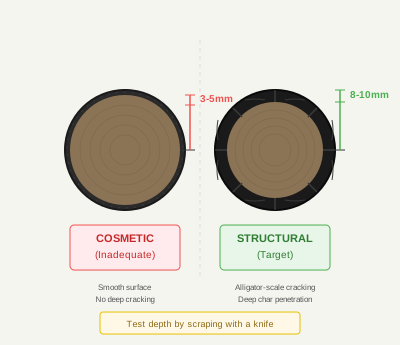
Target 8–10mm char depth with visible alligator-scale cracking -
Bend into Arch Frame While Green
Freshly debarked, freshly charred poles are still at high moisture content from the living tree — peak bending flexibility. Assemble the arch frame immediately. Clamp, lash, or bolt poles into their curved positions while they bend easily.
-
Dry in Place (2–3 Weeks)
With the arch frame assembled, allow the structure to dry in position. Wood fibres lock into the curved shape as moisture content drops. Protect from rain with tarps if no roof is in place yet. Check joints and re-tighten lashings as the wood shrinks. Use a moisture meter — target below 15% before sealing.
-
Seal with Hot Linseed Oil
Heat linseed oil to 60–70°C. Brush on all pole surfaces above the charred zone. The oil hardens over 2–3 days and waterproofs the wood while remaining breathable. Linseed oil also deters insects mildly and resists fungal colonisation. Reapply every 5–10 years — this is the maintenance trade-off you accept for skipping the borax soak.
Protocol B — The Extended-Life Protocol
Section titled “Protocol B — The Extended-Life Protocol”Six steps, adds a borax soak. Targets 30–40 years above-ground service life. The sequencing matters — char goes before borax, so the heat-opened cellular structure of the charred zone receives the borax solution at depth.
-
Debark Within 48 Hours
As above.
-
Char Bottom 50cm (Deep Char Method) — Before the Borax Soak
As above. Charring before the borax soak (rather than after) opens up the cellular structure of the most rot-vulnerable section, so when the poles go into the bath the borax solution penetrates significantly deeper into that zone.
-
Borax Soak (72+ Hours)
Submerge poles completely in borax solution. They float, so weight them down with stones or a weighted board. Minimum 72 hours; longer (up to 2 weeks) is better for deep penetration. Long arch poles (Gothic Arch, Earth-Sheltered SolarPod rafters) benefit from 5+ days.
-
Bend into Arch Frame While Wet
Poles coming out of the borax soak are saturated and at peak flexibility. Assemble the arch frame immediately — clamp, lash, or bolt poles into their curved positions while they bend easily.
-
Dry in Place (2–3 Weeks)
As in Protocol A.
-
Seal with Hot Linseed Oil
As in Protocol A. With borax inside the wood and linseed sealing the outside, reapplication can stretch to every 8–10 years.
Protocol C — The No-Burn Foot (When Fire Is Banned)
Section titled “Protocol C — The No-Burn Foot (When Fire Is Banned)”Both protocols above open with the same move: charring the buried 50cm. That char is the buried-section defence — a carbonised, nutrient-free, hydrophobic skin that lets a blue-gum foot survive in the ground long enough to reach the 15–20 year pole life the Regenerative Default promises. But open flame is exactly what you can’t use during the Portuguese período crítico. The fire-ban season runs through the dry months, and our own fire-safety alert levels call for no open flames from YELLOW upward. A propane torch charring pole-butts on a dry hillside in August is the precise activity the ban exists to stop — and heat-shrink rot sleeves are out for the same reason. If you’re prepping poles in fire season, you need a buried-foot defence that never strikes a match.
This is also where blue gum is weakest. E. globulus is fast-grown, mostly sapwood, with little of the durable heartwood some eucalypts carry; in ground contact it rates around durability class 3, and the field tests are blunt — buried blue gum gets attacked, heartwood and sapwood alike. Untreated, a blue-gum foot in damp winter soil is a 4–8 year proposition. The char was buying most of that life back. Take the fire away and you have to buy it back another way.
Four no-burn options, cheapest first.
Tier 0 — Gravel drainage + sacrificial over-length foot (€0)
Section titled “Tier 0 — Gravel drainage + sacrificial over-length foot (€0)”Keep the gravel bed and collar exactly as specified — a foot that drains and breathes already outlasts one packed in wet clay or, worse, sealed in concrete. Then stop fighting the rot and plan around it: cut arch poles 30–40cm over-length and bury the extra. When the groundline gives out around year 8, pull the pole, saw off the punky foot, and re-set the now-shorter pole in the same hole. The gothic arch flexes mostly in its top third, so it shrugs off losing a hand’s width at the butt. One pole, two lives, no materials, no chemicals — the purest expression of the Regenerative Default.
Tier 1 — The membrane boot (€3–6/pole) — the workhorse
Section titled “Tier 1 — The membrane boot (€3–6/pole) — the workhorse”Wrap the 15cm groundline band in a waterproof membrane so moisture and oxygen can’t reach the wood where they’d otherwise meet. Off-the-shelf, this is a self-adhesive post wrap — RotGuard (SBS-modified bitumen) or peel-and-stick Postsaver Pro-Wrap, both carrying 25-year rot warranties on durable timber. The improvised equivalent is a strip of EPDM pond liner — you may already have it on hand from the soaking trough — glued and taped into a sleeve. The wrap runs from ~5cm above the finished soil line to ~10cm below it, sealed snug top and bottom so it sheds rather than funnels water. The self-adhesive versions need no flame at all — peel, wrap, overlap.
Tier 2 — Boron under the boot (€5–9/pole)
Section titled “Tier 2 — Boron under the boot (€5–9/pole)”Belt and braces: treat the foot chemically before wrapping it. Brush or soak the bottom 50cm in borate solution (the same disodium-borate mix from the Borax Soak Reference below, with a little glycol added to help it diffuse into the wood). Boron is lethal to decay fungi and insects and is about the most benign preservative there is. Its one weakness — it’s water-soluble and leaches straight out of anything in bare ground contact — is precisely why it pairs so well with the membrane: the wrap keeps the boron in. This is essentially the Extended-Life borax defence minus the five-day trough and minus the fire, and it pushes the foot to 20–30 years.
Tier 3 — Don’t bury wood at all: stand it on stone or steel (€0–30/pole) — the outside-the-box answer
Section titled “Tier 3 — Don’t bury wood at all: stand it on stone or steel (€0–30/pole) — the outside-the-box answer”The most durable wooden post is one that never touches soil. Bury something that can’t rot and lash the pole to it above grade, so the wood lives entirely in the dry, breathing air where blue gum is perfectly durable. Two ways to do it:
- Granite pillars (≈€0–20/pole — the regenerative pick). If you have the 1.5m × 10×10cm granite pillars on hand — and in the granite country of the Montanhas Mágicas, stone is the one material that’s genuinely free — set each into the posthole on the same gravel drainage bed, buried 55–60cm (a little deeper than the 40cm wood holes, because the pillar’s job is to take the arch’s inward kick, and its ≈40kg mass plus tamped backfill or a small concrete collar is what resists that thrust). That leaves ~90cm standing proud. Lash the eucalyptus pole to the proud face with galvanized wire at two or three points, butt resting a few centimetres above the soil, never in it. Two details earn their keep: slip a scrap of EPDM between pole and stone at each lashing point so the contact line can’t trap water against the wood, and seal the pole’s end-grain butt with linseed. Granite is geologically inert — no rot, no rust, no leaching, ever — so the pillar is effectively immortal and matches the gabion stone you’re already laying. The foot stops being the failure point: you’re limited by the arch itself, 30+ years.
- Galvanized steel shoe (≈€15–30/pole — the engineered alternative). The same idea in metal: a short length of pipe or a U-bracket welded to a rebar foot, bedded in a small concrete plug over the gravel, with the pole butt sitting on a steel plate a few centimetres clear of the soil and bolted or lashed in. Galvanized steel lasts decades in well-drained gravel. It costs money and welding where the rest of this build wants neither, and the stone does the same job for less — but it’s the off-the-shelf route if granite isn’t to hand.
Choosing
Section titled “Choosing”Rough buried-foot life for a well-drained gravel posthole on a dry-summer Portuguese hillside — where the long rainless summers are quietly on your side (the groundline sits dry for half the year, which is why these run longer than they would in the wet tropics):
| Foot strategy | No fire? | Cost/pole | Expected foot life |
|---|---|---|---|
| Untreated, gravel drainage only | ✅ | €0 | 4–8 years |
| Char the base (Protocols A / B) | ❌ banned in season | €0 | enables 15–20 yr pole life |
| Gravel + over-length sacrificial re-foot | ✅ | €0 | 8 yr × 2 lives |
| Self-adhesive membrane boot (dry pole) | ✅ | €3–6 | 15–25 years |
| Boron soak + membrane boot | ✅ | €5–9 | 20–30 years |
| Granite pillar standoff (pole never buried) | ✅ | €0–20 | 30+ yrs, trivial re-pole |
| Galvanized steel standoff shoe | ✅ | €15–30 | 30+ yrs, trivial re-pole |
For a fire-season build, the recommendation is the membrane boot, applied at the linseed visit — it lands right where the char did on the lifetime curve, costs a few euros, and slots into a day you’re already spending on the frame. If the structure is meant to be permanent, stand the poles on granite pillars and never think about the foot again — it’s the most durable answer here, it costs nothing but the stone you already have, and it’s the most beautiful. Whatever you choose, keep the gravel drainage and the over-length butts: they cost nothing and they’re your free insurance.
Borax Soak Reference (Protocol B Only)
Section titled “Borax Soak Reference (Protocol B Only)”Skip this section if you’re using the Regenerative Default. Everything below applies only when you’re doing the Extended-Life Protocol.
Building a Soaking Trough (Modular Sheet Metal)
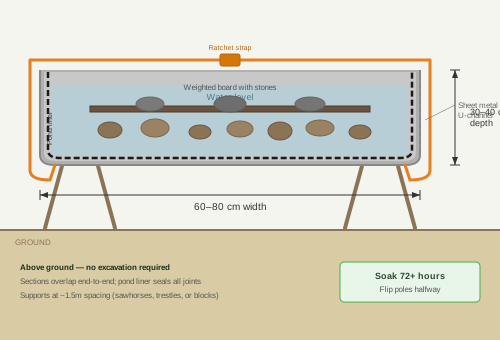
Section titled “Building a Soaking Trough (Modular Sheet Metal)”For batch processing 200+ poles, build a portable above-ground trough from sheet metal sections lined with pond liner. No excavation required — the trough sits on simple supports, can be assembled in an hour, and disassembles flat for transport or storage. Size it to fit the longest poles in your design with clearance:
| Dimension | Size | Rationale |
|---|---|---|
| Length | Longest pole + 0.5m | Must fit your longest poles with clearance (e.g. 12m for 11.6m arch poles) |
| Width | 60-80cm | Depends on sheet size; fits 4-5 poles side-by-side per layer |
| Depth | 30-40cm | Shallower than a trench — above-ground so no depth lost to ground level |
| Capacity | Length × 0.7m × 0.35m × 1000 | e.g. 12m trough ≈ 2,940L; treats 15-20 poles per batch |
Construction Steps
Section titled “Construction Steps”- Source sheet metal: Corrugated roofing sheets, flat galvanized sheet, old signage, or salvaged panels — anything rigid enough to bend into a U and hold water when lined.
- Bend into U-channels: Bend each sheet into a broad U shape (~60-80cm wide, ~30-40cm deep). Use a brake or fence post for flat sheet; corrugated sheets fold by hand along the ridges.
- Set up frame: Place supports (sawhorses, timber trestles, or stacked blocks) along the run at ~1.5m spacing. Level them carefully — water finds every low spot.
- Line up sections: Lay U-channels end-to-end on the frame, overlapping edges by 10-15cm at each joint.
- Install pond liner: Drape EPDM (1mm) or heavy polyethylene (200+ micron) along the full length inside the channel run. The liner seals all joints between sections — no need for waterproof connections in the metalwork.
- Strap it down: Run ratchet straps around the frame and channels every ~1m to hold everything tight and prevent the sides from splaying under water weight.
Borax Solution Recipe
Section titled “Borax Solution Recipe”| Ingredient | Amount per 1,000L | Cost (approx) |
|---|---|---|
| Water | 1,000 liters | — |
| Borax (sodium borate) | 12.5kg | €19-25 |
| Boric acid | 8.3kg | €12-21 |
This creates approximately a 2% solution — sufficient for insect and fungal protection. Scale proportionally to your trough volume. Dissolve borax and boric acid in hot water first, then add to trough.
Batch Processing Workflow
Section titled “Batch Processing Workflow”- Load batch: Slide 15-20 debarked poles into trough using ramps
- Submerge: Weight down with stones or a board weighted with concrete blocks
- Cover: Lay tarp or corrugated sheets over trough to reduce evaporation
- Soak 72+ hours: Flip poles halfway through if any surfaces exposed
- Remove and bend: Slide poles out and assemble into arch frames immediately while saturated and flexible
- Repeat: Solution remains effective for 6-8 batches before needing refresh