Foundation: Gabion Ring
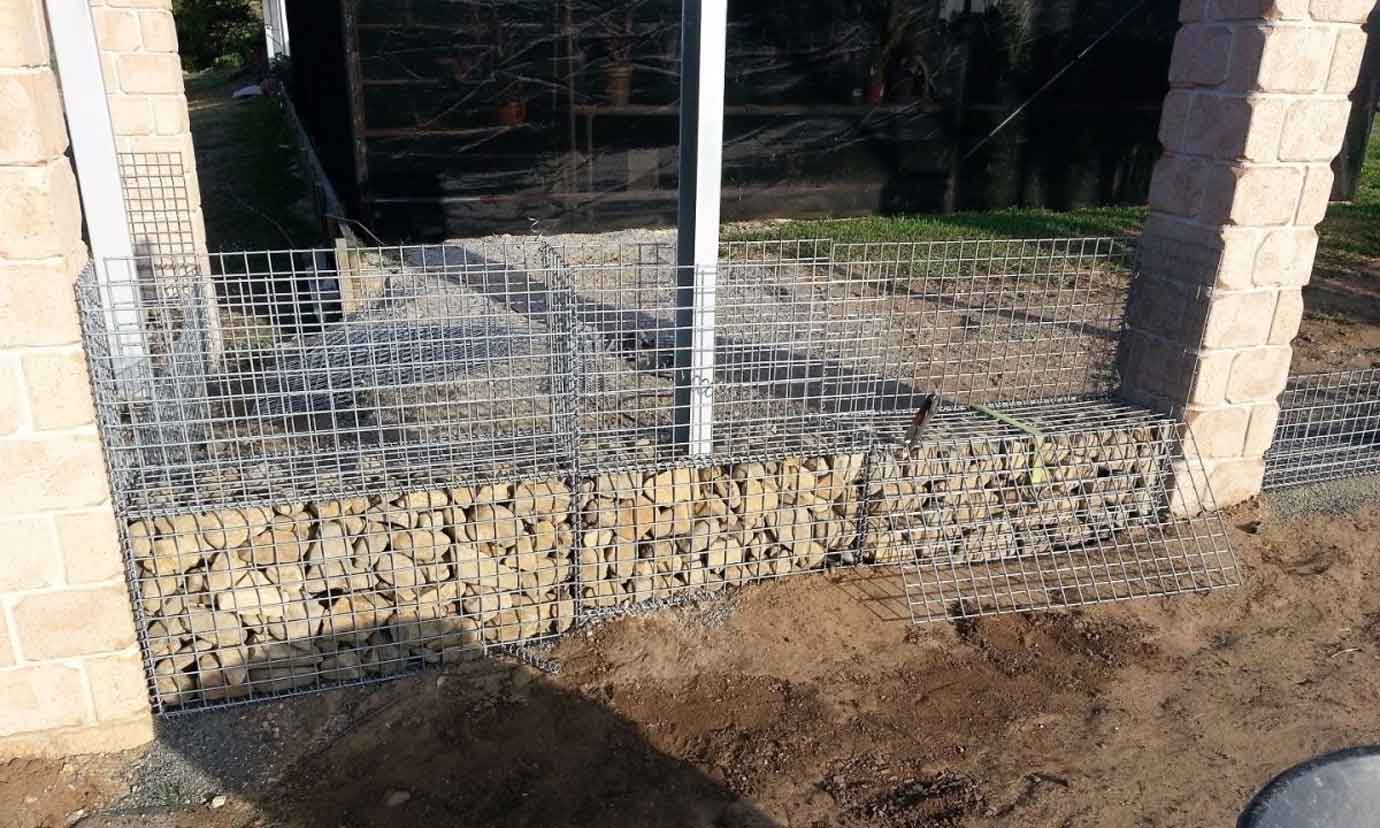
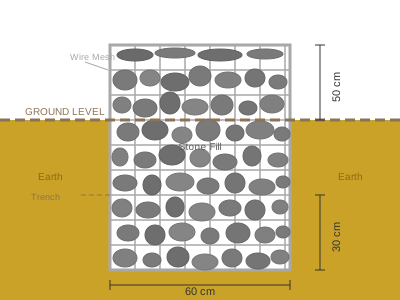
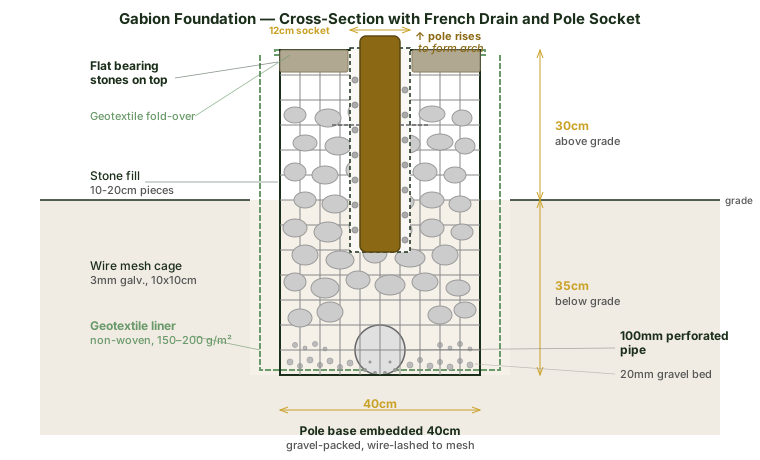
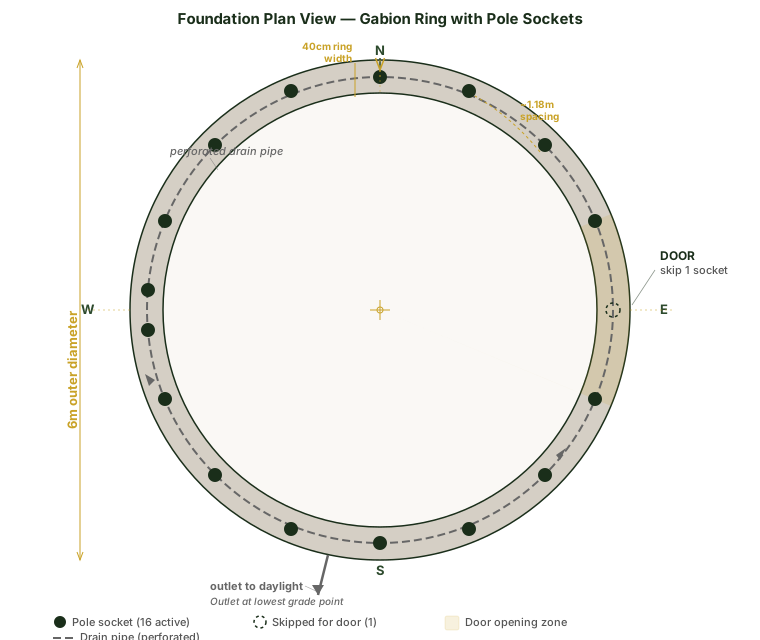
The foundation is a 6m diameter ring of gabion baskets filled with local stone. It does four things: keeps the pole bases off wet ground, anchors the dome against wind, provides a level starting surface, and drains subsurface water away from the structure. The gabion ring doubles as a French drain — a geotextile-lined trench with a perforated pipe at the bottom collects groundwater and carries it to daylight downhill.
Specifications
Section titled “Specifications”- Outer diameter: 6m
- Ring width: 40cm
- Height: 30cm above grade, 35cm below (65cm total)
- Fill: Local granite or schist, 10-20cm pieces
- Top surface: Flat stones creating level bearing for pole bases
Drainage Specifications
Section titled “Drainage Specifications”- Geotextile: Non-woven, 150–200 g/m², full wrap including fold-over top
- Drain pipe: 100mm perforated HDPE (corrugated preferred), on 50mm gravel bed
- Slope: 1–2% continuous fall toward outlet (~10cm total drop around circumference)
- Outlet: 100mm solid pipe, ≥2m to daylight downhill
- Gravel: 20mm washed, 50mm deep under and around pipe
Construction Sequence
Section titled “Construction Sequence”-
Mark the Circle
Drive a stake at center. Attach a 3m string and scribe the outer perimeter. Then scribe the inner edge at 2.6m.
-
Identify the Outlet Point
Walk the perimeter with a spirit level. Find the lowest grade point — this is where the drain will exit. Mark it clearly. The trench bottom will slope toward this point from both directions around the ring.
-
Excavate Ring Trench
Dig 35cm deep at the outlet point, ~25cm deep at the opposite point. 50cm wide. This gives a 1–2% continuous slope from the high side to the outlet. Compact the bottom — errors here propagate through the entire build.
-
Line with Geotextile and Lay Pipe
Lay 160cm-wide non-woven geotextile strips along the trench, overlapping strips by 30cm. Spread a 50mm gravel bed (20mm washed gravel) on top of the geotextile at the bottom. Lay 100mm perforated HDPE pipe on the gravel bed with perforations facing down. At the outlet point, connect to a 100mm solid pipe that exits the ring and runs ≥2m to daylight downhill.
-
Assemble Gabion Cages
3mm galvanized wire mesh, 10x10cm openings. Form into cages 40cm wide, 65cm tall. Wire-tie every 15cm. Lower cages into the lined trench. The geotextile wraps up between the cage and the trench wall on both sides.
-
Fill and Level
Pack gravel around the pipe first — 50mm cover above the pipe. Then fill with stone, compacting every 10cm. Fold the geotextile over the top of the fill before placing the final flat bearing stones. Check level around the entire perimeter with a long straight edge and spirit level.
-
Pole Sockets
At 16 equally-spaced points around the ring (every ~1.18m), leave a 12cm-wide gap in the top stones. These are the sockets for the main dome poles. At the position directly opposite the door, add a second socket right next to the first (15cm apart, center to center) — the fanning pair needs one socket per butt end. That gives 17 sockets total. Mark them clearly. Skip one socket where the door will go — you will install a door frame here instead.
-
Wind Porch Gabion Extension
At the door opening, build a U-shaped gabion extension for the wind porch foundation. Two arms project 1.2m outward from the main ring at each edge of the door opening, connected by a cross piece at the outer end. Same specs as the main ring: 40cm wide, 65cm deep, geotextile-lined, stone-filled, flat bearing stones on top. The U-shaped extension creates a level footing for the four porch corner posts and defines the porch floor area.
-
Test the Drain
Pour a bucket of water into the gabion fill at the point farthest from the outlet. Verify that water flows out at the daylight end within minutes. If flow is slow or absent, check the pipe slope and connections before proceeding.