Door, Wind Porch, Windows & Apex Vent
Arch Door (Double Bay)
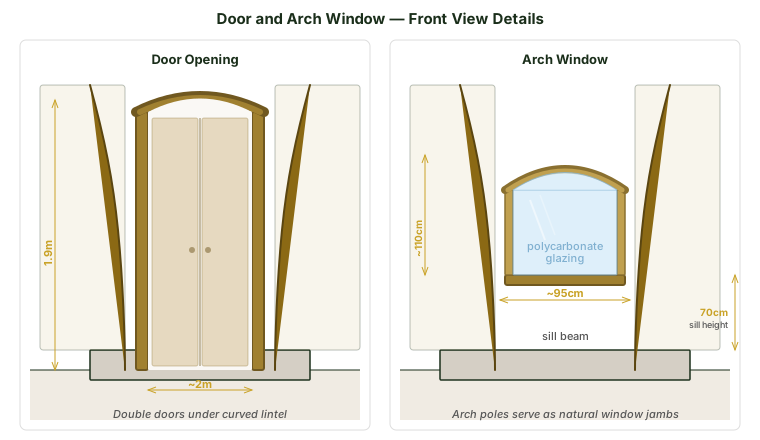
Section titled “Arch Door (Double Bay)”The door spans a double bay — two pole spacings wide, created by skipping one socket. The eighth arch pair — the door-framing pair — fans from the two sockets opposite the door, and its thin ends land at the two sockets flanking the opening, forming a natural arch over the entrance. This gives a generous ~2m-wide doorway.
- Width: ~2m (spanning two pole bays)
- Shape: The fanning pair curves apart as it descends from the crown, creating a pointed arch that separates at roughly 2.2m height. Below that, two treated chestnut or pine posts (10cm diameter) stiffen the straight sides down to the foundation.
- Frame: Two treated chestnut or pine posts set into the gabion, rising to 1.5m. Above 1.5m, the fanning pair’s descending thin ends provide the arch.
- Threshold: Treated timber sill beam across the foundation at the base of the opening
- Door itself: Double ledge-and-brace timber doors (each leaf ~1m wide), or a heavy curtain for warm months
Install the door frame posts during the dome frame phase, before weaving. The door-framing pair is installed after the seven standard pairs (see Raising the Arches, Step 4). The wattle weave terminates at the door edges on each side.
Wind Porch (Katak)
Section titled “Wind Porch (Katak)”The 6m catenary dome wall leans roughly 15 degrees inward from vertical at the base. A door frame mounted directly on this slanted surface will not hang plumb, the sill will slope inward, and rain drives straight in. The wind porch solves all three problems: a short arched tunnel projecting outward from the dome at the door, inspired by the igloo katak (entrance tunnel). The porch arch profile matches the door — straight walls up to 1.5m, then a curved arch to the peak — so the two read as one continuous opening.

Dimensions
Section titled “Dimensions”- Projection: 1.2m outward from dome face
- Width: 2m (matches double-bay door opening)
- Height: 2.2m at inner end (dome arch), 2.0m at outer door frame
- Internal clear depth: ~1.0m (after wall thickness)
Structure
Section titled “Structure”- 4 corner posts (10cm treated chestnut/pine, plumb vertical) in gabion footings — posts rise to 1.5m (where the arch begins)
- 2 side eave poles connecting inner to outer posts at 1.5m (arch spring line)
- Inner arch frame matching the dome door arch profile (peak at 2.2m)
- Outer arch frame matching the same profile (peak at 2.0m — slightly lower for roof drainage)
- 5 arch rafters curving from inner arch to outer arch, forming a barrel-vault roof
- Wattle-weave sidewalls below the arch spring line and infill between rafters
- Same layer stack as dome: straw-clay (100mm), burlap, EPDM, stone skirt + lime render
Foundation
Section titled “Foundation”U-shaped gabion extension: two 1.2m arms projecting from the main ring at the door edges, connected by a cross piece. Same specs as the main ring (40cm wide, 65cm deep, geotextile-lined). See Foundation, Step 8.

Arch Windows & Window Boxes
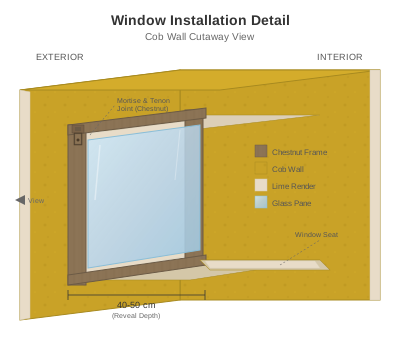
Section titled “Arch Windows & Window Boxes”Install 2-3 arch-topped windows in the natural bays between adjacent arch poles. The poles act as the window jambs, so you only need to add a sill beam, two short vertical stiles, and a curved arch frame at the top.
Like the door, each window sits on a dome wall that leans inward. A 20cm-deep window box projects outward from each opening, giving a plumb outer frame for the glazing.
- Shape: Rectangular below, arch-topped above — following the natural curve between two poles
- Size: ~95cm wide (the natural pole spacing) × ~110cm from sill to arch peak
- Sill height: 70cm above foundation (comfortable seated eye level)
- Inner frame: Treated chestnut or pine: horizontal sill beam, two short stiles up to where the arch begins (~1.3m), then a curved arch frame to the peak (~1.8m). Install during the dome frame phase, before weaving.
- Window box: 4 short treated frame members (20cm long) at each corner project outward from the dome EPDM surface. Small-scale wattle and straw-clay cheek walls fill between the dome surface and the outer frame.
- Outer frame: Plumb frame at the outer end of the box, with rebate for glazing.
- Glazing: Fixed polycarbonate sheet (6mm), mounted in the plumb outer frame with butyl tape seal. The polycarbonate sits in the rebate of the outer frame — plumb, not leaning.
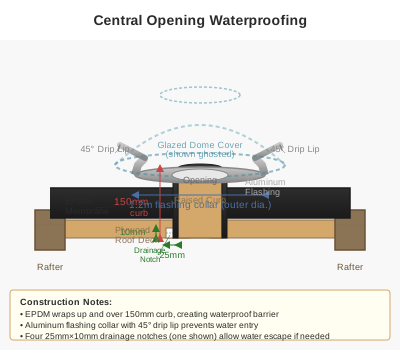
- Sill slope: 5 degrees outward for drainage, with an EPDM drip edge extending 5cm past the outer face.
- Placement: At least one window opposite the door for cross-ventilation. Orient the largest window south for passive solar gain in winter.
Window Box EPDM Detail
Section titled “Window Box EPDM Detail”Cut the dome EPDM in a picture-frame pattern at each window opening. Fold the four flaps into the box sides and seal to the frame members with primer and seam tape. The sill flashing is a separate EPDM piece that covers the sill, slopes outward at 5 degrees, laps over the dome EPDM below the window, and extends 5cm past the outer face as a drip edge.

Apex Vent
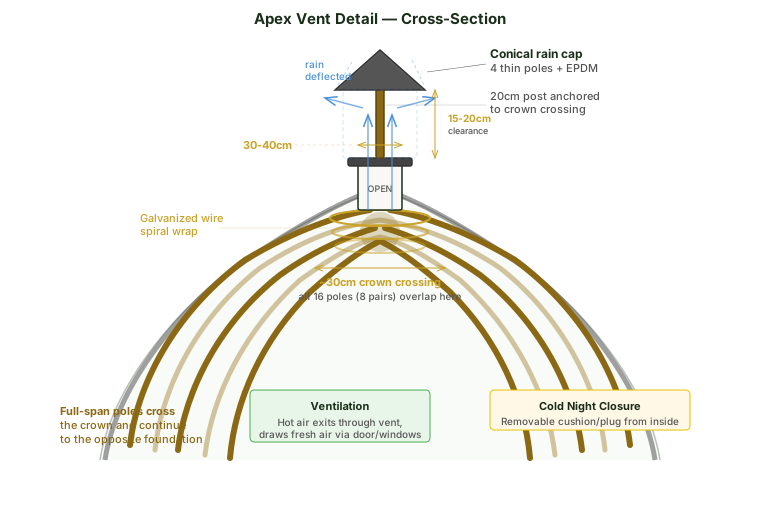
Section titled “Apex Vent”The 30-40cm opening at the crown of the dome serves as the primary ventilation. Hot air rises and exits here, drawing fresh air in through the door and windows.
- Opening: 30-40cm diameter, formed at the center of the crown crossing where all 16 poles (8 pairs) overlap
- Rain cap: A conical cap on a short post (like a chimney cowl), mounted 15-20cm above the opening. Allows air flow while deflecting rain.
- Construction: Bend 4 thin poles into a cone, cover with a small piece of EPDM. Mount on a 20cm post anchored to the crown crossing.
- Closure: For cold nights, stuff the opening with a removable cushion or plug from inside.