Wattle Weave
Wattle is the oldest building technique in the world. Thin flexible poles woven between structural members to create a dense lattice. On this dome, horizontal rings and vertical infill turn the arch skeleton into a solid surface ready for straw-clay.
Horizontal Rings
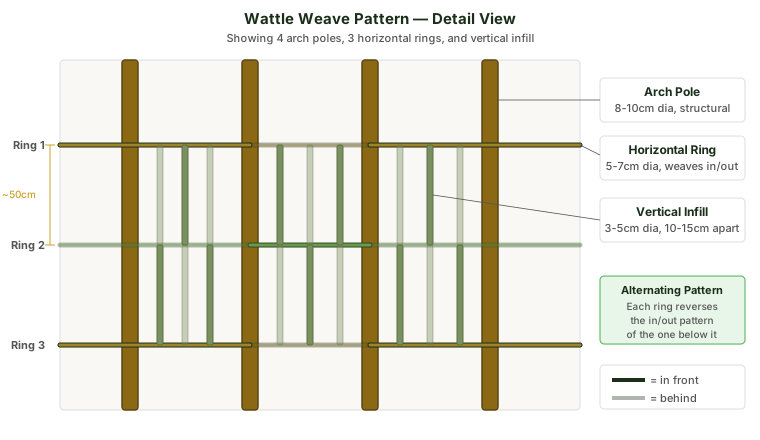
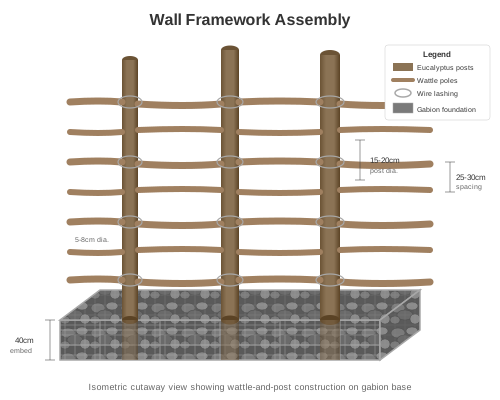
Section titled “Horizontal Rings”Install 7 horizontal rings at roughly 50cm vertical spacing up the dome. Each ring is a continuous circle of wattle poles woven in and out of the 16 main arch poles.
- Poles: 5-7cm diameter, green eucalyptus
- Ring 1 (lowest): ~50cm above foundation, circumference ~18m
- Ring 7 (highest): ~3.5m up, circumference ~5m
- Pattern: Weave in front of one arch pole, behind the next, alternating
- Joining: Where pole ends meet, overlap by 30cm and wire-lash
- Alternation: Each ring reverses the in/out pattern of the one below it
The lower rings are long — you may need 2-3 poles spliced end-to-end to complete one ring. Upper rings may need only one pole bent into a circle.
Vertical Infill
Section titled “Vertical Infill”Between each pair of horizontal rings, weave vertical wattle poles to fill the gaps.
- Poles: 3-5cm diameter, 1-1.5m length, green — harvest the same day you weave
- Spacing: Every 10-15cm around the dome
- Pattern: Weave behind one horizontal ring, in front of the next
- Quantity: Approximately 150-200 poles total
Work from the bottom up. The lower sections have wider spacing between arch poles (more infill needed). The upper sections converge and need less infill.
Density Check
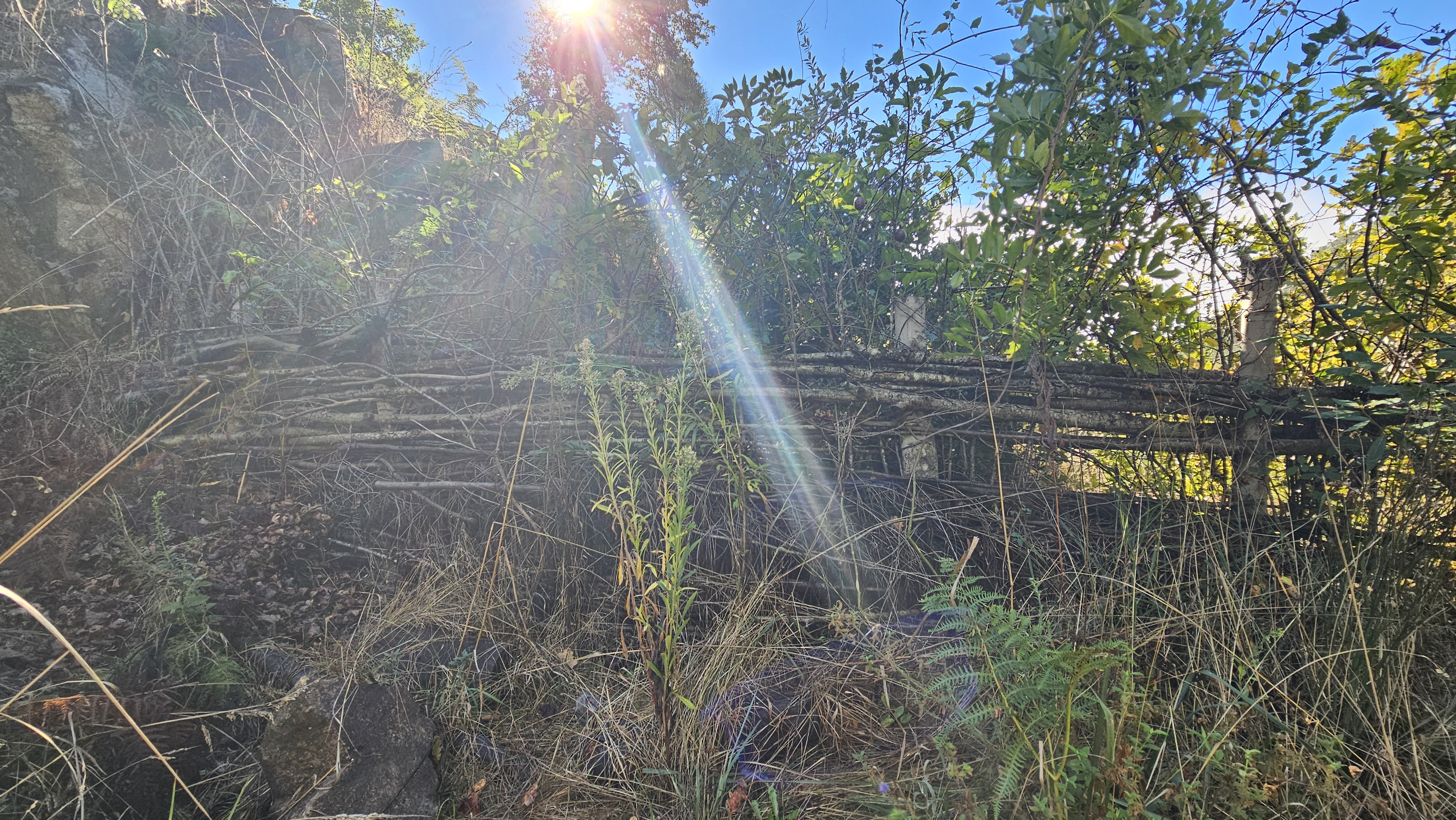
Section titled “Density Check”When the weave is complete, you should not be able to push your fist through any gap in the lattice. If you can, add more infill poles. The straw-clay needs a tight matrix to key into.